
Server Side Rendering (SSR) means generating the HTML for a page on the server instead of in the browser. When a user requests a page, the server runs your Vue components, produces complete HTML, and sends it. The browser shows the content immediately, then JavaScript loads and makes the page interactive (hydration).
How SSR works in Vue
1. Browser requests /about
2. Server creates a Vue app instance
3. Server runs components, resolves async data
4. Server renders the component tree to an HTML string
5. Server sends the HTML + serialized state to the browser
6. Browser displays the HTML instantly (content visible)
7. JavaScript bundle loads
8. Vue "hydrates" the static HTML: attaches event listeners, makes it interactive
SSR vs CSR (Client Side Rendering)
With CSR (the default SPA approach), the server sends an empty HTML shell and the browser builds the entire page with JavaScript:
CSR:
  Server sends → <div id="app"></div> + JS bundle
  Browser downloads JS → executes → renders content
  User sees blank page until JS finishes

SSR:
  Server sends → full HTML with content + JS bundle
  Browser shows HTML immediately
  JS loads in background → hydrates → page becomes interactive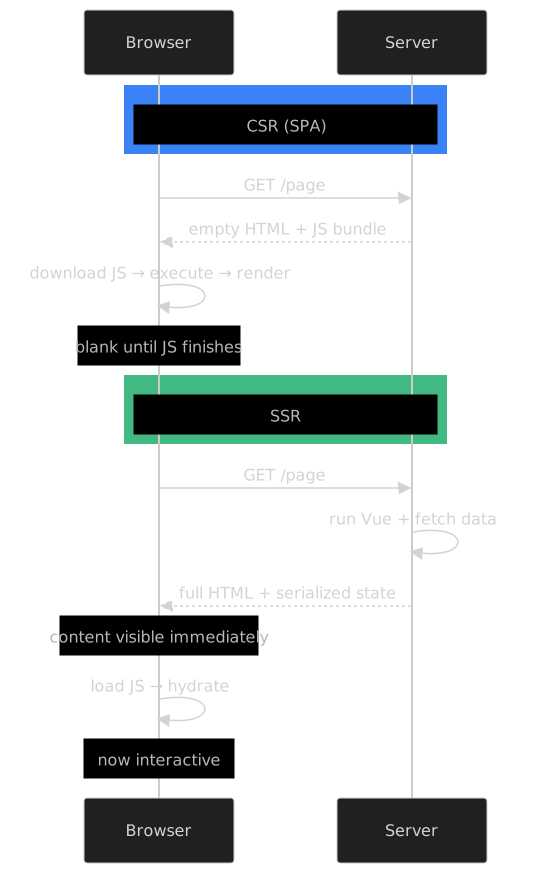
Advantages of SSR
Faster first contentful paint. Users see content before JavaScript loads. On slow connections or low-end devices, this difference is significant.
Better SEO. Search engine crawlers receive complete HTML. While Google can execute JavaScript, other crawlers often can't, and even Google indexes pre-rendered content faster.
Better social sharing. When someone shares a link on Twitter, Slack, or Discord, the preview card is generated from the HTML response. CSR pages show blank previews unless you add separate meta tag handling.
Works without JavaScript. The initial content is visible even if JavaScript fails to load or is disabled. Forms and links can still work through standard HTML behavior.
Disadvantages of SSR
Server cost. Every request runs Vue on the server. A CSR app serves static files from a CDN. SSR needs compute resources that scale with traffic.
Development constraints. Code runs in two environments. You can't use window, document, or browser-only APIs in code that runs on the server. Lifecycle hooks like onMounted only run on the client.
Longer Time to Interactive. The page is visible sooner, but it's not interactive until hydration completes. Users might click a button that doesn't respond yet.
More complexity. State management needs to be SSR-safe (no singletons). Third-party libraries might not support SSR. Debugging spans two environments.
SSR in Vue without a framework
Vue provides @vue/server-renderer for manual SSR:
// server.js
import { createSSRApp } from 'vue'
import { renderToString } from 'vue/server-renderer'
import App from './App.vue'

async function render(url) {
  const app = createSSRApp(App)
  const html = await renderToString(app)
  return `
    <!DOCTYPE html>
    <html>
      <body>
        <div id="app">${html}</div>
        <script src="/client.js"></script>
      </body>
    </html>
  `
}// client.js
import { createSSRApp } from 'vue'
import App from './App.vue'
const app = createSSRApp(App)
app.mount('#app') // hydrates existing HTML instead of replacing itNote createSSRApp instead of createApp. This tells Vue to hydrate existing markup rather than creating new DOM.
SSR with Nuxt (the practical approach)
Nuxt handles all the SSR plumbing for you: server rendering, hydration, state serialization, code splitting, and platform-specific API guards:
// nuxt.config.ts
export default defineNuxtConfig({
  ssr: true // this is the default
})
No manual server setup, no separate entry files, no state serialization code. This is why most Vue SSR apps use Nuxt.
When to use SSR
| Use case | SSR? |
|---|---|
| Marketing site, blog, docs | Yes, or prerender (SSG) |
| E-commerce product pages | Yes (SEO + performance) |
| Dashboard behind login | No (CSR is simpler, no SEO needed) |
| Real-time collaborative app | Maybe (SSR for initial load, then CSR) |
| Static site with no dynamic data | SSG (prerender at build time) |
See also: What is hydration? · What causes SSR hydration mismatches? · What are the rendering modes in Nuxt?
References
- Server-Side Rendering - Vue.js docs
- Rendering - Nuxt docs
- Vite SSR - Vite docs